The last few days have been testing equipment. I discovered that I am quite hard on equipment and this was obvious when I had new bindings on the Skintecs - they now have racing bindings and it just goes to show the difference between touring bindings and racing bindings. The touring bindings grip the middle section of the NNN bar at the toe of the boot. The racing bindings grip the bar at either end. Thus, this is a batter grip, and it doesn't allow the lateral wear leading to the play that I ahd experienced. But as always, there is a downside - racing bindings will only lock down if all traces of snow and ice are removed - this makes them more time consuming putting skis back on after crossing a road, but this is something that you don't do when racing!
This was a real eye opener and I changed the bindings on my other skis as well. I finally switched to the new skins for the Skintec skis - I had been saving them for the RR rather than use them in training. They are supposed to last about 2,000 km, but mine are pretty worn at 1,000 km. I did discover that worn skins are better for skating, and even though they look badly worn, they still have a decent grip.
So now I am here; equipment all tested, a better build up training than normal - instead of a frantic 3-4 days, I have done 245km over 8 days, with today being almost a rest day - just a quick 11km this morning.
It turns out that the two Australians I met at Nordseter bus stop a couple of years ago liked the idea and have come along this year, and they told some other people. The RR generally gets spread around by word of mouth - someone hears about it from someone else, and so it goes on.
The conditions are good; the temperature not so great - it was +1C yesterday evening, although -1C this morning, later rising to 0C. With no wind, and the drier air here, it was quite pleasant outside in just a long sleeved shirt.
The forecast is generally for just below 0C and as I look outside now, it is gently snowing. In the UK, the kids would be going crazy over the thought of snow.
So I now look forward to the start and see if the improvements I have made work out.
Wednesday, 9 March 2016

Saturday, 5 March 2016
Training now in Kuusamo
Today it snowed on and off. On the downside, this made it slower. However, with the well worn inserts in my Skintec skis, it was possible to skate - only about 300-500 metres at a stretch. But it does demonstrate that my balance is coming back and that an old dog can learn new tricks!
Finnair had removed every last liquid from my ski bag, including ones they have let pass many times before. One is a citrus base remover - non-flammable and non-pressurised. I guess they were just bored on a Friday might. They also swabbed both me and my carry on rucksack for explosives.
At least they didn't get my anti-icing spray - Jussi's father is driving up so we gave him all the stuff that we thought Finnair might steal based on past experience, so it was even more galling that they took stuff they have been happy with previously.
Finnair must be the least cross country ski friendly airline in existence - they have lost my bags more than every other airline put together - losing my bags on about 1 flight in 5, and now they are taking even safe liquids. Maybe I should put the citron base remover in a perfume bottle, as that is more or less what it is. Considering how many gallons of alcohol and perfume they carry on the plane to try and sell us, it is farcical.
Frequently cross country skiers are flying in to places where some of these things are not easy to get. If you arrive the evening of the RR briefing, you are not going to be able to replace anything Finnair take before you have to start skiing, and you will be 4 days into the RR before you see a shop (Ranua) so even getting the stuff is difficult. So it is the time and inconvenience that it costs that are the biggest annoyance.
Getting the bags here was hard enough - my ticket to Helsinki was Finnair, except the return leg was a codeshare with British Airways. So the outward flight had no baggage allowance, and I had to pay €15 per bag for 2 bags (€30); but the return flight, because it is a codeshare, you are under BA's baggage policy, which is one bag included and £60 (€85) if paid in advance (more if paid on the spot).
Thus you are between a rock and a hard place - BA charge you 5x or more than Finnair charges, but Finnair effectively take that amount out of the skier's bags (at least if you are a cross country skier). SAS seem to be better for baggage - you get one bag included, so with two of us we had one bag and one ski bag, and no excess charges (and they didn't raid my bags either).
Finnair had removed every last liquid from my ski bag, including ones they have let pass many times before. One is a citrus base remover - non-flammable and non-pressurised. I guess they were just bored on a Friday might. They also swabbed both me and my carry on rucksack for explosives.
At least they didn't get my anti-icing spray - Jussi's father is driving up so we gave him all the stuff that we thought Finnair might steal based on past experience, so it was even more galling that they took stuff they have been happy with previously.
Finnair must be the least cross country ski friendly airline in existence - they have lost my bags more than every other airline put together - losing my bags on about 1 flight in 5, and now they are taking even safe liquids. Maybe I should put the citron base remover in a perfume bottle, as that is more or less what it is. Considering how many gallons of alcohol and perfume they carry on the plane to try and sell us, it is farcical.
Frequently cross country skiers are flying in to places where some of these things are not easy to get. If you arrive the evening of the RR briefing, you are not going to be able to replace anything Finnair take before you have to start skiing, and you will be 4 days into the RR before you see a shop (Ranua) so even getting the stuff is difficult. So it is the time and inconvenience that it costs that are the biggest annoyance.
Getting the bags here was hard enough - my ticket to Helsinki was Finnair, except the return leg was a codeshare with British Airways. So the outward flight had no baggage allowance, and I had to pay €15 per bag for 2 bags (€30); but the return flight, because it is a codeshare, you are under BA's baggage policy, which is one bag included and £60 (€85) if paid in advance (more if paid on the spot).
Thus you are between a rock and a hard place - BA charge you 5x or more than Finnair charges, but Finnair effectively take that amount out of the skier's bags (at least if you are a cross country skier). SAS seem to be better for baggage - you get one bag included, so with two of us we had one bag and one ski bag, and no excess charges (and they didn't raid my bags either).
Friday, 4 March 2016
RR1 2016 - coming soon to a trail near you
Well here we are
again - another year, another RR.
Each year is
different, and after two years of being injured in the run up to the RR, I have
taken it very carefully. I had a week of training early on - back in
mid-December in Norway, when snow was a bit thin on the ground. Fortunately
where we were staying, there were a few kilometres of good tracks thanks to
snow making, but the other tracks were challenging, being reminiscent of the RR
in a warm year.
Having made good
friends over the years on the RR, I have travelled to Finland a few days
earlier than I normally do, with the intention of spreading my training over a
longer period of time. What I learned in Norway was that some of the ankle
muscles that were giving me a problem became better after about a week.
However, regular running made them twinge again - it might be down to the fact
that many of our local roads have a significant sideways slope on them.
The best intentions
of the treadmill and the rowing machine, and even running club fell away as we
have been replacing the kitchen, and I know better than to go away leaving a
job unfinished. I keep thinking that as I get older, work will dry up, but instead
find myself busier than ever, and it is interesting work.
So I find myself in
Finland probably slightly less fit, but I have managed to lose weight, so I may
yet be my lightest RR starting weight.
I have been staying
with Jussi just north of Helsinki for a few days, and have go three days skiing
in. I am advised that I have managed to get some of the nest weather recently
for it as well. The first day, Tuukka - another RR regular joined us.
Having other people
observe your skiing is helpful. Both observed that they thought my ski poles
were too short, especially for double poling. Those of you who have followed my
saga over the years may remember that I started with 150cm, on the advice of one
trainer, then dropped to 145cm and last year I returned to 150cm.
So the following
day, we were skiing where there is a rental shop, so I rented a pair of 155cm
poles. My height is 182cm, and above the poles, it recommended 150cm poles for
a height of 181cm, so the rental guys thought I was on the right length of
pole. However, I rented some 155s and off I went. On the level, it was hard to
tell - certainly no feeling that they were any worse. They were clearly much
better when double poling, and generally an improvement also going uphill. And
longer poles help on the odd occasions I try my balance with a few skating
steps.
So new poles it was,
and at this time of year, the ski season is winding down, so I got new poles at
a good discount. Generally the more you pay, the lighter they are. As a skier
with not the greatest balance, I probably stress mine more than a good skier
would, and a broken pole in the middle of nowhere is not a great experience, so
I pretty much bought the best.
But it also set me
thinking of the Dave Brailsford approach. For those of you who don't know, he
was, until recently, the head coach of British cycling and the Sky Team that
took British riders to Tour de France wins. So he knows a thing or two about
how to succeed. Part of his philosophy is to make hundreds of tiny
improvements; each by itself may have little significance but several hundred
0.001% improvements start to add up.
I had previously
calculated that I plant each pole about quarter of a million times on the RR
(half a million in total). So I started thinking - what does a lighter pole
mean? Well suppose it is 1g lighter - then over the 7 days and 450km, this
equates to 250kg less that you lift each time as you bring your pole forward.
This is 1 ton per 4g, and it is not unreasonable to see a difference of 100g
between mid range and top range poles. 100g equates to 25 tons of effort extra
on each arm over 7 days - an average of 3.5 tons per day.
When you look at it
like this, that is a significant effort, and I now understand that what may
seem trivial, when you look at it over a longer period of time, can be very
significant.
Although other
people had also told me that they thought I should use longer poles, and in any
case I can always use the others I brought with me, I was heartened to chance
upon another skier taking his daily exercise in Helsinki - none other than a
fellow RR skier who I hadn't seen for a couple of years - Tor-Frederic. Tor is
about my height, a little younger, and although a better skier (he is a Finn)
not hugely faster than me, and I have skied alongside him many kilometres over
the years. So I was quite encouraged when checking his poles that he is skiing
with 160cm poles.
Another point was
made to me by my fellow skiers - I have actually improved, and I might now have
improved some of my techniques (very definitely NOT all of them) where a
different pole length may be now better for me than the standard advice, which
is typically given to novice and gentle recreational skiers.
There is one other
thing that has changed - my eyesight. What, you may well think, has my eyesight
got to do with skiing? Well, I have been wearing variofocals, where you have to
look through the upper part of the lens to get the distance in focus. But as
the difference between distance and reading prescriptions has got greater, the
distance vision gets more and more limited. So I recently had a pair of glasses
made with only distance vision. Thus, I now have to look more through the
centre of the lens, so my head is now being held higher. As a result, my body
angle has changed a little, and as a result longer poles may be a better fit
for my revised "stance".
Of course, now I am
an "expert" (NO, not really, just know slightly more than I did
before) I am now more critical of the poles - despite being "large"
on the hand grips, these were very tight with thin gloves, and would be
impossible with thicker gloves when it is colder. Also, the baskets were very
small, and had a lovely two dimensional curve - great on well prepared tracks,
but not big enough for the softer non-compacted snow more common on the RR. So
I had a good lesson from Jussi in how to change them. You need a heat gun, a
pair of welding or heat resistant gloves and special Swix ski basket glue. You
carefully play the heat over the basket and end of the stick until it loosens
the bond and you can pull the old basket off. Then you melt new glue on, push
up the new basket and align it with the grip before it cools and sets. The
point to watch is that poles have different diameters - we measured 10mm at the
top of the old basket, but when it was off, a 10mm replacement was too big and
the actual end of the pole was 9mm and we needed a 9mm basket. How they are
labelled (or not in many cases) leaves you not being sure exactly what will fit
until you are half way through the job.
Still it is all
done, and I now have a custom set of ski poles for the RR - make me feel like a
pro, but not like one if you have ever seen me ski.
Naturally we have
all been watching the weather forecast evolve for some time now, and each day
the forecast gets a bit warmer and we have been debating waxed, zero or skins
for our ski choice.
So far, I have
probably defied my family's expectations that I will return with yet another
set of skis, but a set of zero skis may be calling to me. For those who don't
know what these are, they are skis that only work around 0C plus or minus a
degree or so. Six years ago, I wondered why anybody would want, or would want
to spend the money on, more than one pair of skis. As someone who has bought 4
sets of skis since my first RR, I don't think I can argue that case any more.
So I am now sat in
the departure lounge at Helsinki waiting for the late flight to Kuusamo for my
final training. That is where I will also do some comparative testing in the
conditions we expect for the RR.
Thursday, 22 October 2015
Another year, another RR
The cutting of the odds to 2/1 for a white Christmas in the UK reminded me that it is time to sign up for the next RR (2016). For the first time in 3 years, it is October and I am not injured. I even managed to complete a half marathon (Brussels) at the start of the month and achieve my aims
My first RR (2010) was hard - I wasn't quite sure what to expect. For some reasons, the falls I had hurt, one of my legs swelled significantly, probably through poor technique. But each year I find a few improvements I can make. I once looked up how much you deteriorate with age, and if you are not a serious athlete, then it is in the range of 03% to 0.7% - at least for running. Over the last two decades I have managed, on average, to keep my long weekly run to about the same sort of time - better when I am fitter, not so good when I take time off or are coming back from injury.
So looking at some of the areas I have improved over the years:
Muscles - I both run and ski now with compression socks - after suffering with shin splints, I find these have prevented a recurrence, and I now longer have problems skiing either. I also discovered that I am not the only one wearing them on the RR either. For more extreme conditions e.g. a competitive half marathon, I also may wear compression shorts to support across the front of the thighs. This is where I had a muscle problem last year, which was probably triggered by having to adapt my technique when my skis were icing up. This also shows the delicate interactions between you, technique, equipment and conditions.
Clothing - I more or less got this right from the outset - several layers, all breathable, seem to be the optimum. Northern Finland has an oddity - look at the top of tall chimneys e.g. the power stations and you will see the smoke is more or less horizontal from the chimney, indicating a strong wind. Normally, the wind at ground level would be 2/3 of that, but you are barely aware of wind at ground level most of the time. I suspect that the forest provides shelter, but even where it is more exposed, the wind is less than I would expect (but then I do live in one of the windier areas in England). I have some good layers that I would normally wear as an outer layer when not raining in the UK because they are wind proof, but have found that they trap the moisture too much when skiing.
Skis and equipment - on this I am definitely not an expert. In the hands of an expert, well waxed skis are the solution most of the time. On the RR, there is a waxing service available at most of the overnight stops, and I always make use of this. However, when the temperature creeps above 0C, it gets a little trickier - first the softer waxes, and then klijster. Last year, I tried the Atomic Skintec skis and found they worked fine. I had a few issues on a couple of days with them icing, but that was my fault; you live and learn, and I will make sure I have good anti-icing next time.
Nutrition - unlike a lot of people, I find it hard to eat much at the rest stops (and even eating a big breakfast and evening meal is hard - exercise tends to reduce my appetite instead of increasing it). After much experimentation, I have found gels that don't freeze easily, and nutrition bars that don't either freeze and break your teeth (yes, one year, someone broke a tooth on chocolate at -30C), or "suck" all the moisture out of your mouth. I also found a tube of wine gums good for a small amount of sugar, and sticks of liquorice (a Finnish favourite) good when you want a bigger sugar hit.
Which finally brings me to the hardest point - technique. I hope I have improved over the years. After the first year, I have somehow learned how to fall without hurting myself, a skill that has avoided broken bones on a couple of occasions in falls last year on the street. I have got better at pacing myself. Fitness and weight also have a bearing. I need more lateral strength in my ankles and better balance - I envy those who can effortlessly skate on skis - I am just too slow at transferring my weight from one ski to another in tricky situations. So this is the thing I need to work on this winter in preparation - technique, fitness, balance and losing a bit more weight would also help.
So with only 140 days to go to the start of the RR, I need to move my training up a gear. Losing 7kg is ideal, although even 2kg would make a significant difference. My sailing club is getting a gig - for rowing - which should help with upper body strength (for double poling), and I will have to look at ways of strengthening the ankles.
- Not injuring myself, or making the minor ankle problem worse
- Finishing ahead of my daughter; if she keeps up her training, this will be the last time I manage to beat her
- Finishing in a reasonable time considering my fitness is only 90-95%
My first RR (2010) was hard - I wasn't quite sure what to expect. For some reasons, the falls I had hurt, one of my legs swelled significantly, probably through poor technique. But each year I find a few improvements I can make. I once looked up how much you deteriorate with age, and if you are not a serious athlete, then it is in the range of 03% to 0.7% - at least for running. Over the last two decades I have managed, on average, to keep my long weekly run to about the same sort of time - better when I am fitter, not so good when I take time off or are coming back from injury.
So looking at some of the areas I have improved over the years:
Muscles - I both run and ski now with compression socks - after suffering with shin splints, I find these have prevented a recurrence, and I now longer have problems skiing either. I also discovered that I am not the only one wearing them on the RR either. For more extreme conditions e.g. a competitive half marathon, I also may wear compression shorts to support across the front of the thighs. This is where I had a muscle problem last year, which was probably triggered by having to adapt my technique when my skis were icing up. This also shows the delicate interactions between you, technique, equipment and conditions.
Clothing - I more or less got this right from the outset - several layers, all breathable, seem to be the optimum. Northern Finland has an oddity - look at the top of tall chimneys e.g. the power stations and you will see the smoke is more or less horizontal from the chimney, indicating a strong wind. Normally, the wind at ground level would be 2/3 of that, but you are barely aware of wind at ground level most of the time. I suspect that the forest provides shelter, but even where it is more exposed, the wind is less than I would expect (but then I do live in one of the windier areas in England). I have some good layers that I would normally wear as an outer layer when not raining in the UK because they are wind proof, but have found that they trap the moisture too much when skiing.
Skis and equipment - on this I am definitely not an expert. In the hands of an expert, well waxed skis are the solution most of the time. On the RR, there is a waxing service available at most of the overnight stops, and I always make use of this. However, when the temperature creeps above 0C, it gets a little trickier - first the softer waxes, and then klijster. Last year, I tried the Atomic Skintec skis and found they worked fine. I had a few issues on a couple of days with them icing, but that was my fault; you live and learn, and I will make sure I have good anti-icing next time.
Nutrition - unlike a lot of people, I find it hard to eat much at the rest stops (and even eating a big breakfast and evening meal is hard - exercise tends to reduce my appetite instead of increasing it). After much experimentation, I have found gels that don't freeze easily, and nutrition bars that don't either freeze and break your teeth (yes, one year, someone broke a tooth on chocolate at -30C), or "suck" all the moisture out of your mouth. I also found a tube of wine gums good for a small amount of sugar, and sticks of liquorice (a Finnish favourite) good when you want a bigger sugar hit.
Which finally brings me to the hardest point - technique. I hope I have improved over the years. After the first year, I have somehow learned how to fall without hurting myself, a skill that has avoided broken bones on a couple of occasions in falls last year on the street. I have got better at pacing myself. Fitness and weight also have a bearing. I need more lateral strength in my ankles and better balance - I envy those who can effortlessly skate on skis - I am just too slow at transferring my weight from one ski to another in tricky situations. So this is the thing I need to work on this winter in preparation - technique, fitness, balance and losing a bit more weight would also help.
So with only 140 days to go to the start of the RR, I need to move my training up a gear. Losing 7kg is ideal, although even 2kg would make a significant difference. My sailing club is getting a gig - for rowing - which should help with upper body strength (for double poling), and I will have to look at ways of strengthening the ankles.
Tuesday, 7 April 2015
2015 RR after event review
After a few weeks I take time to reflect and see what I have learned.
It was a gamble with the Atomic Redster Skintec skis - one of the most expensive skis in the range. I had the waxed skis to fall back on. When I bought them, I had no idea what the conditions would be on this year's RR, but after last year's warm one, I wanted a better option for warmer conditions. Last year people had success with "zero" skis and similar types, but these were not so good when the temperature reached +10C.
This year there were a number of people with the Skintecs, and equivalents from other manufacturers. My own experience was that apart from the problem with icing - I will make sure that I get some good anti-icing spray for next time, they turned out to be everything I expected them to be, and I have to thank the guys at Sport Beitostolen in Norway for introducing me to them. More than that, every single piece of equipment I bought from Sport Beitostolen did exactly what they said it would do. It is very rare that you find a shop where the people are experts and use the equipment they sell themselves so that they know precisely what it will do and its limitations.
The Norwegian boots made by Alfa were the most comfortable ones I have ever had, and were good at keeping the slush and meltwater out when we had warmer conditions. I was also surprised at how much more comfortable the lighter Swix ski poles were, and the narrow small rucksack was definitely and improvement over the belt bag, and I managed to avoid carrying too much more - the main additional weight was the alternate Skintec inserts, which proved to be a good idea on a couple of occasions.
I contemplated the possibility of using a handwarmer to help clear ice off the skis - yesterday in a shop in Brussels I discovered a small rechargeable battery powered one about the width of the skis, so I went back and bought it. It reaches a temperature of 40C and lasts for a couple of hours and charges from USB. So if I tape some bubble wrap together to make an insulating pouch, I can thaw a pair of inserts in my backpack whilst skiing on a spare set. Of course, de-icer in the first place to prevent icing is the best idea.
And a simple switch on/off handwarmer is a handy thing to have in extreme cold. It can even be charged from my solar charger. This leads to some interesting possibilities - cross country skis with solar cells on the top to heat the grip area to prevent icing (call it a non-iSki!!).
Looking forward to next year, I can cut my skis down to just two pairs - the Atomic Redster Skintecs and a pair of waxed skis as a standby; poles will now be just two pairs of 150cm poles - the 145cm may have improved my technique at one point, but I am now better back on 150cm. Boots will be the Alfas, with one spare pair. I will stick to my normal habit of using the professional waxing service - obviously just glide wax on the Skintecs.
With all this, I have now reached as far as I can get in improving equipment and matching it to my capabilities, so I really have to up my capabilities, which means finding ways and means of strengthening certain muscles. Revisiting roller skis is something I will look at again.
So for now, it is a question of keeping as much fitness as I can until late summer when I start my campaign for next year's RR and hope to avoid injury.
It was a gamble with the Atomic Redster Skintec skis - one of the most expensive skis in the range. I had the waxed skis to fall back on. When I bought them, I had no idea what the conditions would be on this year's RR, but after last year's warm one, I wanted a better option for warmer conditions. Last year people had success with "zero" skis and similar types, but these were not so good when the temperature reached +10C.
This year there were a number of people with the Skintecs, and equivalents from other manufacturers. My own experience was that apart from the problem with icing - I will make sure that I get some good anti-icing spray for next time, they turned out to be everything I expected them to be, and I have to thank the guys at Sport Beitostolen in Norway for introducing me to them. More than that, every single piece of equipment I bought from Sport Beitostolen did exactly what they said it would do. It is very rare that you find a shop where the people are experts and use the equipment they sell themselves so that they know precisely what it will do and its limitations.
The Norwegian boots made by Alfa were the most comfortable ones I have ever had, and were good at keeping the slush and meltwater out when we had warmer conditions. I was also surprised at how much more comfortable the lighter Swix ski poles were, and the narrow small rucksack was definitely and improvement over the belt bag, and I managed to avoid carrying too much more - the main additional weight was the alternate Skintec inserts, which proved to be a good idea on a couple of occasions.
I contemplated the possibility of using a handwarmer to help clear ice off the skis - yesterday in a shop in Brussels I discovered a small rechargeable battery powered one about the width of the skis, so I went back and bought it. It reaches a temperature of 40C and lasts for a couple of hours and charges from USB. So if I tape some bubble wrap together to make an insulating pouch, I can thaw a pair of inserts in my backpack whilst skiing on a spare set. Of course, de-icer in the first place to prevent icing is the best idea.
And a simple switch on/off handwarmer is a handy thing to have in extreme cold. It can even be charged from my solar charger. This leads to some interesting possibilities - cross country skis with solar cells on the top to heat the grip area to prevent icing (call it a non-iSki!!).
Looking forward to next year, I can cut my skis down to just two pairs - the Atomic Redster Skintecs and a pair of waxed skis as a standby; poles will now be just two pairs of 150cm poles - the 145cm may have improved my technique at one point, but I am now better back on 150cm. Boots will be the Alfas, with one spare pair. I will stick to my normal habit of using the professional waxing service - obviously just glide wax on the Skintecs.
With all this, I have now reached as far as I can get in improving equipment and matching it to my capabilities, so I really have to up my capabilities, which means finding ways and means of strengthening certain muscles. Revisiting roller skis is something I will look at again.
So for now, it is a question of keeping as much fitness as I can until late summer when I start my campaign for next year's RR and hope to avoid injury.
Wednesday, 18 March 2015
RR day 7 - making it to the end
This year we have a new route for the last day. The first part is the same route we had to use last year, due to lack of snow, but they have now added 34km beyond this to take us down to the Tornio river some 35km north of Tornio.
My plan is to take the bus to the first bus rendezvous point - I have skied that bit before, and see if I can very gently ski the remainder with my leg strapped up. At least this way, I should not keep everyone waiting at the end, as the buses will wait, rather than do a shuttle back and forwards to the hotel.
First the bus drops our bags off at the hotel. Super Liisa cannot ski today - she put her shoulder joint out whist doing a warm up exercise and it took several people to put it back in and strap it up. I walk quickly to the Apoteek (chemist) to see if I can get strapping for my thigh. No, they don't have anything that big, but send me on to the physio centre round the corner. They do not have anything that big.
In the end, I manage to improvise by using a calf strap. A bit tight, but it works. I also discover now why my ski trousers zip all the way up or down the sides - so you can get at strapping easily. It is a beautiful day for skiing - nice conditions, blue skies. At one point after adjusting the strapping, I suddenly find I have much more control of my skis again - clearly that muscle has been weak all along.
It is a beautiful day

Keen to welcome us, at one rest stop they have erected covered shelter and have benches for us to sit on whilst we eat.

Alongside these trails in various locations are new wooden huts - some are in clusters and are a lean-to type shelter with fire area in front - presumably in the summer for sleeping out overnight, or even in the winter if you have a good sleeping bag. I am not quite sure of the purpose of these huts.

I have seen similar ones housing ecologically sound toilets, but this one is a bit larger.
Another couple of good lessons - find suitable thigh strapping (I have various ankle straps, knee straps and a calf strap - almost all actually unused, but just in case) and find exercises to strengthen the muscle. Also, take care to allow longer to come back from injury.
Today's trail:

The grey line running down the river is the border between Sweden (on the left) and Finland (on the right).
So I have completed it again, and at least finished on a high. Injury and lack of daylight caused me to lose about 50km, which was very frustrating. But looking back there were a lot of people who skipped more because of the conditions.
And for anyone who is interested in the effort it takes:

This shows the training around Kuusamo, and allowing for some recovery before starting the RR. But after that it is off the scale and it also shows it takes a week afterwards to fully recover just from the physical effort. In theory, I need to get myself significantly fitter in order that this level of effort is not so hard and does not go off the scale.
My plan is to take the bus to the first bus rendezvous point - I have skied that bit before, and see if I can very gently ski the remainder with my leg strapped up. At least this way, I should not keep everyone waiting at the end, as the buses will wait, rather than do a shuttle back and forwards to the hotel.
First the bus drops our bags off at the hotel. Super Liisa cannot ski today - she put her shoulder joint out whist doing a warm up exercise and it took several people to put it back in and strap it up. I walk quickly to the Apoteek (chemist) to see if I can get strapping for my thigh. No, they don't have anything that big, but send me on to the physio centre round the corner. They do not have anything that big.
In the end, I manage to improvise by using a calf strap. A bit tight, but it works. I also discover now why my ski trousers zip all the way up or down the sides - so you can get at strapping easily. It is a beautiful day for skiing - nice conditions, blue skies. At one point after adjusting the strapping, I suddenly find I have much more control of my skis again - clearly that muscle has been weak all along.
It is a beautiful day
Keen to welcome us, at one rest stop they have erected covered shelter and have benches for us to sit on whilst we eat.
Alongside these trails in various locations are new wooden huts - some are in clusters and are a lean-to type shelter with fire area in front - presumably in the summer for sleeping out overnight, or even in the winter if you have a good sleeping bag. I am not quite sure of the purpose of these huts.
I have seen similar ones housing ecologically sound toilets, but this one is a bit larger.
Another couple of good lessons - find suitable thigh strapping (I have various ankle straps, knee straps and a calf strap - almost all actually unused, but just in case) and find exercises to strengthen the muscle. Also, take care to allow longer to come back from injury.
Today's trail:
The grey line running down the river is the border between Sweden (on the left) and Finland (on the right).
So I have completed it again, and at least finished on a high. Injury and lack of daylight caused me to lose about 50km, which was very frustrating. But looking back there were a lot of people who skipped more because of the conditions.
And for anyone who is interested in the effort it takes:
This shows the training around Kuusamo, and allowing for some recovery before starting the RR. But after that it is off the scale and it also shows it takes a week afterwards to fully recover just from the physical effort. In theory, I need to get myself significantly fitter in order that this level of effort is not so hard and does not go off the scale.
RR day 6 - disaster strikes
Everyone is so keen that some of them ski off before the trail is set. Here you can see the snowmobile and sledge used to set the trail at Hosio - at the bottom of the bank is a frozen river.

The morning goes well and I manage quite a good speed. It is a long 20km or so to our first stop. Shortly after leaving this stop, it starts snowing, and after a couple of kilometers I start to feel pain across the front of my right thigh. I switch to double poling to rest it and then wonder if maybe it is some muscle cramp, so stop for energy gel and a sugary snack. This eases it a bit. I am concerned that despite all the people at the rest behind me, no-one has caught me up and passed me, especially on the icy dips and bumps over the tree roots where I usually slow down noticeably.
The snow gets thicker, and eventually I have the problem with the skis icing. I stop and clear them several times and eventually Eric (the pilot) passes me and I notice the snowmobile. This means that everyone else has quit on this section and I am now last. When I get to the next rest stop, the snowmobile pulls in and I ask for a lift, as having skied on a bad leg for at least 10km I don't really want to make it worse.
It is decided that the rest stop guys will give me a lift to the next point where the bus is. After they pack up, we drive 10km down a narrow lane with the snow ploughed to both sides, occasionally having to pull laden branches out of the way. The driver tells me that the road was only cleared yesterday, specially for them to get access to provide our rest stop. It is little bits of information like this that show you how much goes on behind the scenes to make the Rajalte Rajalla Hiihto possible, and how much of the communities along the way are behind us.
This is the first time in five times that I have had to miss a few kilometres through injury, and another little indication that I am not getting any younger. Looking on the bright side, I can at least look for exercises to strengthen those particular muscles for next year.
Today's shortened track i.e. what I actually skied:

The morning goes well and I manage quite a good speed. It is a long 20km or so to our first stop. Shortly after leaving this stop, it starts snowing, and after a couple of kilometers I start to feel pain across the front of my right thigh. I switch to double poling to rest it and then wonder if maybe it is some muscle cramp, so stop for energy gel and a sugary snack. This eases it a bit. I am concerned that despite all the people at the rest behind me, no-one has caught me up and passed me, especially on the icy dips and bumps over the tree roots where I usually slow down noticeably.
The snow gets thicker, and eventually I have the problem with the skis icing. I stop and clear them several times and eventually Eric (the pilot) passes me and I notice the snowmobile. This means that everyone else has quit on this section and I am now last. When I get to the next rest stop, the snowmobile pulls in and I ask for a lift, as having skied on a bad leg for at least 10km I don't really want to make it worse.
It is decided that the rest stop guys will give me a lift to the next point where the bus is. After they pack up, we drive 10km down a narrow lane with the snow ploughed to both sides, occasionally having to pull laden branches out of the way. The driver tells me that the road was only cleared yesterday, specially for them to get access to provide our rest stop. It is little bits of information like this that show you how much goes on behind the scenes to make the Rajalte Rajalla Hiihto possible, and how much of the communities along the way are behind us.
This is the first time in five times that I have had to miss a few kilometres through injury, and another little indication that I am not getting any younger. Looking on the bright side, I can at least look for exercises to strengthen those particular muscles for next year.
Today's shortened track i.e. what I actually skied:
RR day 5 - the "shortest" day
Well the shortest day is only some 49km. We start this day with a group photo outside the hotel before skiing off. Our usual route takes us up alongside the zoo. Today is gale force winds and at times we are exposed for a kilometre or two and you really do start to get the impression of how bleak and isolated it is. I live in Somerset, one of the largest and least populated counties in England. Ranua commune is about the same size, but has about 1% of the population - about twice the population of my village (Brent Knoll).
Today's skiing is about covering the distance with minimum effort to allow the body to recover as much as possible.
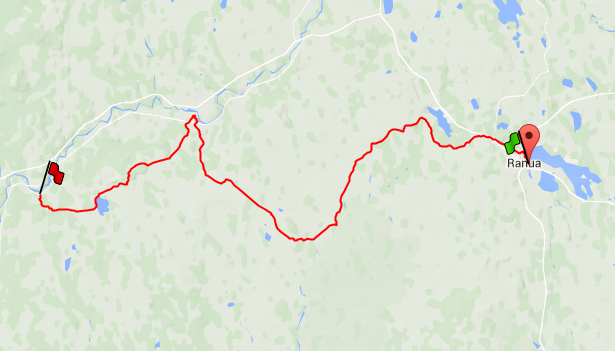
The friendly polar bear is at Ruona (the upward kink in the track on the map above). Half of us are bused back to the village hall there and the rest of us stay in the old school at Hosio. Sleeping bags are the order of the day (or should I say night) here.
Today's skiing is about covering the distance with minimum effort to allow the body to recover as much as possible.
The friendly polar bear is at Ruona (the upward kink in the track on the map above). Half of us are bused back to the village hall there and the rest of us stay in the old school at Hosio. Sleeping bags are the order of the day (or should I say night) here.
Saturday, 14 March 2015
RR day 4 - the longest day
Again, the conditions were changeable - ice, snow, sleet, rain. I made it down the narrow steep slope with only a very minor fall, and was well pleased with myself. However, I really do need to work on my technical skiing - mostly to get the leg and ankle muscles to control the skis better - probably some skating would help - it would certainly improve my balance.
Between the two rest stops with the coaches, I did not see a single skier - the few slower ones behind me were left behind, or took the coach, and the faster ones were all well in front. It was slower and harder going than I had hoped. The general consensus was that the second rest stop had to be cleared by 2pm if you wanted to pass the last stop/checkpoint before the course was closed for safety as night falls. I did make it through here just by that time - the hot soup was definitely a nice reviver.
I occasionally caught up a Finnish lady skiing ahead of me - she would be pulling out of a rest stop as I arrived, but eventually she was out of reach. Suddenly as the temperature dropped as the sun was lowering late afternoon, the track got icy and I found I was able to double pole along at some 12-13km and sustain it for a long time. I overhauled the deficit to the lady in front and passed her, but she then caught on to the same trick and followed me closely all the way into the final checkpoint. However, with the sun having gone below the horizon (it takes about an hour and a half before it is dark at this latitude and time of year), we were too late to be let through for the final few kilometres.
Today's track:
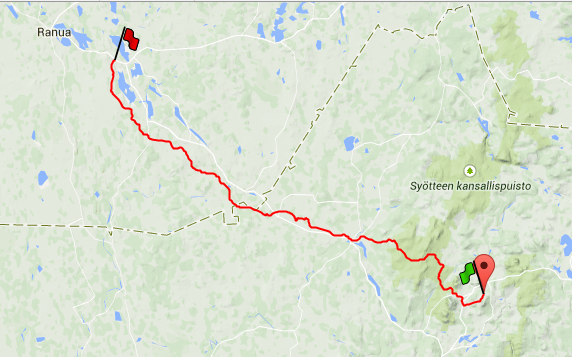
The real finish point is just above the "n" in Ranua.
Between the two rest stops with the coaches, I did not see a single skier - the few slower ones behind me were left behind, or took the coach, and the faster ones were all well in front. It was slower and harder going than I had hoped. The general consensus was that the second rest stop had to be cleared by 2pm if you wanted to pass the last stop/checkpoint before the course was closed for safety as night falls. I did make it through here just by that time - the hot soup was definitely a nice reviver.
I occasionally caught up a Finnish lady skiing ahead of me - she would be pulling out of a rest stop as I arrived, but eventually she was out of reach. Suddenly as the temperature dropped as the sun was lowering late afternoon, the track got icy and I found I was able to double pole along at some 12-13km and sustain it for a long time. I overhauled the deficit to the lady in front and passed her, but she then caught on to the same trick and followed me closely all the way into the final checkpoint. However, with the sun having gone below the horizon (it takes about an hour and a half before it is dark at this latitude and time of year), we were too late to be let through for the final few kilometres.
Today's track:
The real finish point is just above the "n" in Ranua.
Saturday, 7 March 2015
RR day 3 - even more challenging conditions.
A good an uneventful moring, except for having to ski with my older, shorter (145cm) poles. Even though I only changed back up to 150cm poles after 3 years with shorter poles, it goes to show that the shorter poles did the job of getting me to hold them better and not getting tangled up in them, but 150cm is definitely the right length, and I could finally see how much more I am getting out of that extra length.
A little after the lunch stop, the sky turned dark, the wind picked up and it began to snow. Before long, the track was hard to find - even obliterated in places. Sometimes, you were skiing by trying to feel for the tracks (something I have had experience of before).
Towards the end, my skis started to ice up. The first time, I just scraped the ice off the skintec kick zone. Later on, the whole skis felt leaden and stuck to the ground. Checking the skis, even the glide zone was sticking. So to make the last couple of kilometers, drastic measures were called for. Knowing that I have a brand new set of the two stripe skintec modules (carried with me now, after yesterday's incident), and that these have some mileage on the clock (400km), I decided to experiment, and after clearing the snow and as much of the ice as I could, put a layer of liquid glide wax from end to end of the skis, including on the skintec grip zone. The skis were completely transformed, not only gliding well, but also the kick performing well. It was good to get good glide and predictable behaviour Just in time, as the final part of the day is to use the drag lift to get to the centre on the top of the mountain.
This provided some useful learning.
A little after the lunch stop, the sky turned dark, the wind picked up and it began to snow. Before long, the track was hard to find - even obliterated in places. Sometimes, you were skiing by trying to feel for the tracks (something I have had experience of before).
Towards the end, my skis started to ice up. The first time, I just scraped the ice off the skintec kick zone. Later on, the whole skis felt leaden and stuck to the ground. Checking the skis, even the glide zone was sticking. So to make the last couple of kilometers, drastic measures were called for. Knowing that I have a brand new set of the two stripe skintec modules (carried with me now, after yesterday's incident), and that these have some mileage on the clock (400km), I decided to experiment, and after clearing the snow and as much of the ice as I could, put a layer of liquid glide wax from end to end of the skis, including on the skintec grip zone. The skis were completely transformed, not only gliding well, but also the kick performing well. It was good to get good glide and predictable behaviour Just in time, as the final part of the day is to use the drag lift to get to the centre on the top of the mountain.
This provided some useful learning.
- I did not expect the glide zone to ice up. But if faced with these conditions again after skiing some distance, I will be quicker to brush on some liquid glide wax.
- I will track down some proper anti-icing for the waxless skis. But in the meantime, I now know that liquid glide wax is at least a potential problem solver in extreme conditions.
- In these extreme conditions, it makes sense to periodically check the skintec modules for icing. Also, test out if anti-icing will keep the keyhole free of ice to be able to quickly change modules.
I will have to investigate other means of de-icing - will some of these thermal hand warmers provide a means of thawing them out? If the air temperature is above zero, then swapping the modules out with spares from time to time would allow the modules not in contact with the tracks to thaw out.
Here is today's route:
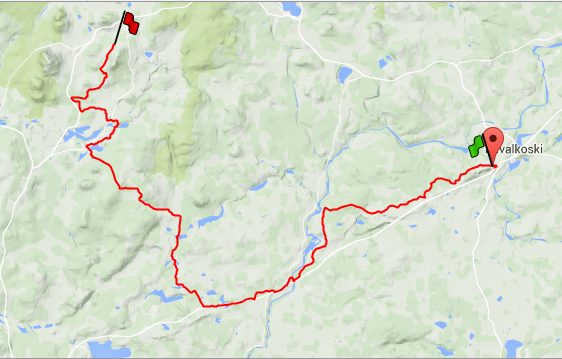
Here is today's route:
RR day 2 -some challenging skiing conditions.
On the bus to the starting point, a friend asked me if magnets were strong enough to hold the modules in place on the skintecs. At this point, I had never had any problems, but this would come back to haunt me before the day was out.
The first half of the day is 30km mostly along an old railway track. Without pushing too hard, I did this in record time - about three and a half hours, arriving just before midday. It gives me a bit of confidence that despite a drop off on my balance and technical skiing, never good at the best of times (and redeemed a bit later in the day on some tricky steep slopes), I can at least pound out the kilometers on the more gentle parts of the course.
However, around the three quarter point, I was having a bit of trouble with the skis sticking, so stopped to check them before a steep descent. Horror, of horrors - one skintec module was missing. I let people at the back know to keep an eye open for it, but a kind skier had found it and caught me up just before the finish to reunite me with it. Fortunately, I had been carrying the better grip modules as spares.
It highlights a couple of interesting points. Firstly, how did it come to be lost? On examination when I found I had lost it, the other module had some icing. I suspect there is a point where a module ices up and the grip of the ice to the snow/ice below is greater than the attraction between the magnets. But it also shows that under some circumstances, the snow packing into the cavity left when a module is removed can provide decent grip, if slightly sticky and unpredictable. This does at least give an option to try in tricky conditions when all else has failed.
The conditions this happened in was freshly falling snow, just above zero, perhaps just below as the point at which it happened was on a climb.
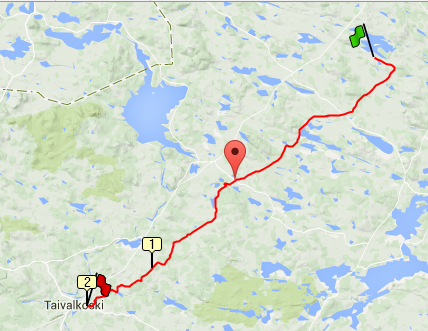
A nice gentle day, except for the hills at the end.
The first half of the day is 30km mostly along an old railway track. Without pushing too hard, I did this in record time - about three and a half hours, arriving just before midday. It gives me a bit of confidence that despite a drop off on my balance and technical skiing, never good at the best of times (and redeemed a bit later in the day on some tricky steep slopes), I can at least pound out the kilometers on the more gentle parts of the course.
However, around the three quarter point, I was having a bit of trouble with the skis sticking, so stopped to check them before a steep descent. Horror, of horrors - one skintec module was missing. I let people at the back know to keep an eye open for it, but a kind skier had found it and caught me up just before the finish to reunite me with it. Fortunately, I had been carrying the better grip modules as spares.
It highlights a couple of interesting points. Firstly, how did it come to be lost? On examination when I found I had lost it, the other module had some icing. I suspect there is a point where a module ices up and the grip of the ice to the snow/ice below is greater than the attraction between the magnets. But it also shows that under some circumstances, the snow packing into the cavity left when a module is removed can provide decent grip, if slightly sticky and unpredictable. This does at least give an option to try in tricky conditions when all else has failed.
The conditions this happened in was freshly falling snow, just above zero, perhaps just below as the point at which it happened was on a climb.
A nice gentle day, except for the hills at the end.
RR day 1 the tortoise and the hare or to wax or not to wax!
For my first RR back
in 2010 I arrived in Kuusamo with a single pair of traditional waxless skis. Or
rather I arrived 24 hours before my skis. So I spent the first day on rented
waxed skis. Testing back to back convinced me at that time that the extra effort
required of waxless skis on an endurance event was too high a price to pay.
Since then, I have
on tricky occasions on subsequent RRs tried waxless again but never found the
advantages to outweigh the disadvantages.
So despite testing
it was with great trepidation that I stood at the start of the RR on waxless
skis. The first few kilometres were exciting but that was down to a lack of
technical skills on my part and a
recovering ankle.
The skintecs worked
well. Frequently people would pass me only to stop and re wax skis trying to
find something that worked.
After the soup stop in early afternoon, I swapped out the double strip (better glide and less kick) for the full width single strip (more kick/grip and less glide). I did find a minor problem when trying to change - the little hole for the key gets filled with ice and it takes a while to prise the ice out to be able to get the key in to swap.
But all in all, they cope very well with changing conditions from below zero to above zero, from loose fresh snow to pack ice in the tracks.
Today was a total of 61.65km according to the GPS - from close to the Russian border through to the top end of the city of Kuusamo - as shown on the map.


Today was a total of 61.65km according to the GPS - from close to the Russian border through to the top end of the city of Kuusamo - as shown on the map.
As can be seen from the picture of me at the start, I am not very good at selfies, especially with gloves and with by breath fogging it up.
I arrived in Kuusamo at 5.30pm - about the time I normally arrive. But I took it steady today in order to save energy. The mistake I made in my first year was to put too much effort into the first day. This is not a mistake I have ever made again. For someone with my level of fitness, conservation of energy is important if I am to make it through the week.
Tuesday, 3 March 2015
Last minute training - part 2
Well sometimes the results defy all logic. Having done 7 laps of a pretty much flat 7.35km circuit round the lake yesterday, today I did more, but with variations on skis. This is the training circuit I have been using in Kuusamo - starting and finishing behind the Sokos hotel.

I expected to find that waxed skis were faster. This is NOT what happened. I had to exclude the first lap, as the tracks had not been recently prepared and it was fresh snow. So the effort was higher and the time longer, as would be expected.
To cut down on the number of tests, I am comparing skis that have not had glide wax ironed on for quite a while - so the glide on both waxed and waxless (skintecs) is typical more of what it is at the end of a long day's skiing. It also takes another variable out of the equation.
For the second lap, I put the full width skintec module in for the first time - this should give more grip but glide less well. It pretty much matched the second lap of yesterday on every measurement - not what would be expected unless today's conditions are faster; the temperature is the same +1C rising to +2C.
For the third lap, waxed skis - my Salomons - with a red wax. Definitely not as good a grip, but when repeated later, with the grip wax redone, the grip was pretty good, going up the same short inclines much as the waxless did. This lap was slower and more effort.
Lap 4, after lunch, back on the skintecs - heart rate and effort higher - very much as yesterday's lap 4 - so it is consistent (and demonstrates why you don't ski on a big meal).
Lap 5 - back on the waxed Salomons, and the slowest lap of the two days. The waxing was good, at least to start, but towards the end of 7km, it felt like it had been abraded off.
And the conclusions are:

I expected to find that waxed skis were faster. This is NOT what happened. I had to exclude the first lap, as the tracks had not been recently prepared and it was fresh snow. So the effort was higher and the time longer, as would be expected.
To cut down on the number of tests, I am comparing skis that have not had glide wax ironed on for quite a while - so the glide on both waxed and waxless (skintecs) is typical more of what it is at the end of a long day's skiing. It also takes another variable out of the equation.
For the second lap, I put the full width skintec module in for the first time - this should give more grip but glide less well. It pretty much matched the second lap of yesterday on every measurement - not what would be expected unless today's conditions are faster; the temperature is the same +1C rising to +2C.
For the third lap, waxed skis - my Salomons - with a red wax. Definitely not as good a grip, but when repeated later, with the grip wax redone, the grip was pretty good, going up the same short inclines much as the waxless did. This lap was slower and more effort.
Lap 4, after lunch, back on the skintecs - heart rate and effort higher - very much as yesterday's lap 4 - so it is consistent (and demonstrates why you don't ski on a big meal).
Lap 5 - back on the waxed Salomons, and the slowest lap of the two days. The waxing was good, at least to start, but towards the end of 7km, it felt like it had been abraded off.
And the conclusions are:
- In tricky conditions, the skintecs move from fresh snow to ice to corn snow without any problems. On the other hand, with the waxed skis, the waxing that was good for the tracks was not so good when stepping out into fresh snow and sticking if you came to a stop. For a skier with poor balance like me, this is definitely a plus point for the skintecs.
- On the very slight downhills, the waxed skis did glide slightly better and I was just able to double pole for a bit longer. And although they seemed to glide better, the GPS and effort measurements suggest that at least for me and this set of tests, this was an illusion.
- So why are the skintecs better? They should not be! Well the guy who sold me them (in Norway) said they didn't lose much on the glide. And his workshop had a stack of calibrated skis that he and a colleague use for glide wax testing, so although he didn't give me a figure, his "not much" is maybe something I can't measure. It could well be that I am gaining more from a better kick than I am losing on the glide.
- At the end of the day, someone told me that today's conditions were tricky, so it might just be that round that particular circuit, the changing conditions are such that I am gaining from the wide operating range of the skintecs, compared to it not being possible to optimise waxed skis (at least not when I am waxing them) for a varying set of conditions.
All very interesting. I still find it hard to believe the results, but there they are. The reason this is all so critical to me is that I have only just got the strength/endurance to complete 60-90km per day, and any extra effort required may be just that bit too much.
As can be seen in the above diagram of a week's training, you don't have time to recover from each day's exertion before you start on the next, and most of the above was skiing much shorter distances in Norway, although it did include a lot more climbing - as much most days as for the whole RR. My fitness levels have improved, as a 50% greater training load did not push me up as far into the red. The image above is not cropped - literally I end up going off the top of the scale.
Monday, 2 March 2015
Last minute training - part 1
Sunday 1 March
22 km in morning.
New track round the lake some 7 km is flat. Challenging in places with wind
blown fine snow; icy in other parts. Two circuits of the Tolpaniemi track on
the skintecs was illuminating. I had a fall which resulted in a slight twist of
the ankle at what is my Achilles heel when skiing - namely a fast corner at the
bottom of a hill. Good skiers push off on the corner, but this results in the outer track being
broken. When I get to it my outer ski tries to follow it and go straight on.
In the afternoon I
did the Kuusamo town loop with my newer boots as they have more ankle support.
I also strapped the ankle up.
So what did I learn?
My circuit of the town loop was a few minutes slower than last year but
massively quicker than two years ago. Also, it is possible to strap an ankle up
and still get it into a ski boot and ski without chafing.
At lunchtime I had
taken a closer look at the skintec module and it looked more worn than I
expected. At the end of the day I cleaned it up and it looked better, but I thought that although I have the full
grip module unused it might be wise to get a spare set. So I looked up Atomic
dealers. Intersport is the one in Kuusamo but not open on Sundays.
Monday 2 March
First thing on
Monday I skied round to Intersport. Walked down to skis and my hopes were
raised - Atomic skintecs. But alas, they were the touring version which doesn't
have the replacement module. I guess these are aimed at people who do not ski
so much. I thought I didn't do much at 800km in a year.
Anyway, after a few phone calls and the mention of
the Rajalta Rajalle Hiihto, they can get them for Wednesday. I am not sure if they are coming from
Helsinki or if they are having to get them in from Austria.
The RR may not be so
widely known outside of Lapland despite being the world's longest cross country
ski event but up here it is important.
One of the Sokos hotel's receptionist's husband is the safety snowmobile
driver on our first day.
So how did the
skiing go today? Well it started at
+1C and rose a degree during the day.
Today I decided to do my endurance test rather than risk stressing the ankle.
Since last year they have built a loop round the lake in front of the hotel
which is just over 7km and more or less
flat. This was incredibly busy which for a weekday in somewhere that isn't
especially a resort (that is Ruka 20km up the road).
So I got just over 7
laps -a bit over 50km done (53.6km to be precise). This shows
me that I have the endurance so I can cut down the distance for the next couple
of days to recover. Comparing lap to lap, it appears that I got slower throughout the day but that the training load went up from morning to afternoon, but it was fairly constant for the last three laps in the afternoon.
On enquiring if
today was fast, slow or tricky conditions,
I was told that they were tricky. The skintecs performed flawlessly -
probably a bit slower where snow had blown into the tracks. Not scientific, but on a one degree slope down I was double
poling and keeping pace for a while with those skating - normally much quicker
if you have the ankle strength and can maintain a higher energy output.
So I think that
regardless of scientific testing, for me
they work well and provide a level of confidence that I can take anything in my
stride. They seem good on ice crossing roads and other icy patches. The guy who
sold them to me that I would no longer be like Bambi and so far these skis have
been everything he said they would be.
Good equipment has
an attention to detail. For example, my
small new rucksack has the chest strap higher than most so that it clears the
heart monitor chest strap. But then it is designed for cross country skiing and
mountain biking - people who commonly monitor their performance.
So tomorrow I may do some comparative tests and cut the distance back to about 25-30km and around 15km on Wednesday to allow the body to recover a bit. Professional sports people have trainers to help them figure out how to optimise this, but I have only the one gruelling event each year, so I won't be able to apply this year's "lessons learned" until this time next year.
Saturday, 28 February 2015
En route
3am coach to Heathrow, uneventful, but surprisingly full - only a handful of spare seats.
Arrived Helsinki for a few hours before the connecting flight to Kuusamo. Only a hint of snow in the edges of the fields coming in, and nothing at the airport. There are usually remnants of where the snow has been ploughed, but not today. This means it has been above zero - at least on and off - for some time.
The weather forecast for the RR route several days out is still fluctuating quite a bit, but it is clear that there is some warm air around both this week and during the event.
Just saw an airline I had not previously heard of - Corendon - so Googled it. Interesting, as it does not list flights to Helsinki, which makes you wonder what it is doing here.Hanging around airports has been much less tedious since my bank upgraded its lounge access as part of my banking package to Priority Pass. Before you only got free lounge access if you booked your flight through them.
Still, hanging around the airport is a good time to review what I want to get out of my last few days training. The first objective is to determine how the skintec skis compare on the test track I use in Kuusamo (Tolpanniemen valolatu). By using the heart monitor and GPS, I can measure the effort used for a lap. To be representative of real use, I need to do a set of comparisons
(3) should give the best performance and (2) the worst performance. The interesting comparisons will be (1) and (3) which give the starting point for a day's skiing and (2) and (4) which are indicative of the latter part of a day's skiing.
I will try to aim to ski at approximately the same speed, and do the circuit in roughly the same time. Observations on how well the skis grip uphill will be partly subjective and partly from analysing the data afterwards (bit like in F1 racing).
Comparing effort is quite difficult - my normal Saturday 16km run takes about 93 minutes when I am at full normal fitness. But if I push on, and reduce it to 90 mins - a 3% improvement, it takes 30% more effort (according to the Polar training load). You very quickly get into the realms of diminishing returns. For skiing 60-90km a day, finding the right pace becomes important.
The Tolpanniemen training loop has very varied terrain packed into a short track - up and down, so in later analysis, I will be able to compare the terminal glide velocity on some of the hills - both steep and gentle - to compare the glide performance of the skis. I will also look at how they compare on the flat run to/from the training track, as this is typical of a lot more of the RR in practice.
Armed with these results, and the weather forecast each day, I can determine strategy on a daily basis. If the difference is significant, then waxed skis may be the better choice on colder days when the temperature is stable e.g. mornings and the skintecs in the afternoon, when the temperature is warmer and conditions are fluctuating more. Somewhere around the upper end of the blue kick wax range is probably the dividing point where the more reliable grip of the waxless starts to outweigh the reduced glide performance. The time lost messing around in some conditions trying to get a kick wax to work should not be underestimated. Stop for 6 minutes, and you lose a kilometre! One year, on that day's last section, I lost a good half hour or more. I had three kick waxes covering the range, but whatever I tried, I either had no grip, or was stuck to the spot. Hopefully I am now better at waxing, but there are always conditions where you just don't seem to be able to get it right.
Arrived Helsinki for a few hours before the connecting flight to Kuusamo. Only a hint of snow in the edges of the fields coming in, and nothing at the airport. There are usually remnants of where the snow has been ploughed, but not today. This means it has been above zero - at least on and off - for some time.
The weather forecast for the RR route several days out is still fluctuating quite a bit, but it is clear that there is some warm air around both this week and during the event.
Just saw an airline I had not previously heard of - Corendon - so Googled it. Interesting, as it does not list flights to Helsinki, which makes you wonder what it is doing here.Hanging around airports has been much less tedious since my bank upgraded its lounge access as part of my banking package to Priority Pass. Before you only got free lounge access if you booked your flight through them.
Still, hanging around the airport is a good time to review what I want to get out of my last few days training. The first objective is to determine how the skintec skis compare on the test track I use in Kuusamo (Tolpanniemen valolatu). By using the heart monitor and GPS, I can measure the effort used for a lap. To be representative of real use, I need to do a set of comparisons
- Skintec (waxless) with professionally applied glide wax
- Skintec (waxless) with well worn glide wax
- Waxed with professionally applied glide and kick wax
- Waxed with worn glide wax, but kick wax reapplied
(3) should give the best performance and (2) the worst performance. The interesting comparisons will be (1) and (3) which give the starting point for a day's skiing and (2) and (4) which are indicative of the latter part of a day's skiing.
I will try to aim to ski at approximately the same speed, and do the circuit in roughly the same time. Observations on how well the skis grip uphill will be partly subjective and partly from analysing the data afterwards (bit like in F1 racing).
Comparing effort is quite difficult - my normal Saturday 16km run takes about 93 minutes when I am at full normal fitness. But if I push on, and reduce it to 90 mins - a 3% improvement, it takes 30% more effort (according to the Polar training load). You very quickly get into the realms of diminishing returns. For skiing 60-90km a day, finding the right pace becomes important.
The Tolpanniemen training loop has very varied terrain packed into a short track - up and down, so in later analysis, I will be able to compare the terminal glide velocity on some of the hills - both steep and gentle - to compare the glide performance of the skis. I will also look at how they compare on the flat run to/from the training track, as this is typical of a lot more of the RR in practice.
Armed with these results, and the weather forecast each day, I can determine strategy on a daily basis. If the difference is significant, then waxed skis may be the better choice on colder days when the temperature is stable e.g. mornings and the skintecs in the afternoon, when the temperature is warmer and conditions are fluctuating more. Somewhere around the upper end of the blue kick wax range is probably the dividing point where the more reliable grip of the waxless starts to outweigh the reduced glide performance. The time lost messing around in some conditions trying to get a kick wax to work should not be underestimated. Stop for 6 minutes, and you lose a kilometre! One year, on that day's last section, I lost a good half hour or more. I had three kick waxes covering the range, but whatever I tried, I either had no grip, or was stuck to the spot. Hopefully I am now better at waxing, but there are always conditions where you just don't seem to be able to get it right.
Friday, 27 February 2015
On my way in the morning
Doing the last minute packing. How many pairs of skis should I take? This is a bit easier to answer now - stick with 3 because the Skintecs have most of the advantages of waxed skis with few of the disadvantages of waxless skis i.e. they don't lose much on the glide. But I still don't know how they perform in the really cold temperatures we get e.g. -30C.
At the moment, the long term forecast on www.yr.no for the next 10 days takes me to half way through the RR. It shows a high of +1C for my last two training days in Kuusamo, 0C for the first day of the RR. 0C for the second day (Taivalkoski). -2C for day 3 (Iso Syote) - but this may be at the top of the hill and 0C for day 4 (Ranua).
Of course, there is plenty of time for it to change - a couple of days ago, the forecast showed it dropping to -11C for the end of next week.
The outlook isn't improved by the news item (only available in Norwegian, but thanks to online translation you can get the essence of it) - "This is God-awful things. Mild weather and halke lead goes on the mood loose for the skiglade TV metereologist John Smits. Now he fears plus the degrees for many weeks to come."
Basically, it is looking more and more like last year's weather. Still, I am better prepared - new ski boots with an outer waterproof skin so that my feet don't get wet skiing through water on top of the ice. These are Norwegian boots designed by a specialist company, and design is now taking into account the conditions we face more frequently.
I suppose the next ski evolution should be "hover skis" - they would have fantastic glide; maybe when you weight the ski to get grip, spikes automatically extend into the snow (goodbye klister). These would work with tracks with water in them, and more importantly (for me) I could train without snow. Alas, the theory is good, but the practicality of carrying the energy to produce the air cushion is not. But maybe in 450km of skiing, there may be an eureka moment; who knows?
At the moment, the long term forecast on www.yr.no for the next 10 days takes me to half way through the RR. It shows a high of +1C for my last two training days in Kuusamo, 0C for the first day of the RR. 0C for the second day (Taivalkoski). -2C for day 3 (Iso Syote) - but this may be at the top of the hill and 0C for day 4 (Ranua).
Of course, there is plenty of time for it to change - a couple of days ago, the forecast showed it dropping to -11C for the end of next week.
The outlook isn't improved by the news item (only available in Norwegian, but thanks to online translation you can get the essence of it) - "This is God-awful things. Mild weather and halke lead goes on the mood loose for the skiglade TV metereologist John Smits. Now he fears plus the degrees for many weeks to come."
Basically, it is looking more and more like last year's weather. Still, I am better prepared - new ski boots with an outer waterproof skin so that my feet don't get wet skiing through water on top of the ice. These are Norwegian boots designed by a specialist company, and design is now taking into account the conditions we face more frequently.
I suppose the next ski evolution should be "hover skis" - they would have fantastic glide; maybe when you weight the ski to get grip, spikes automatically extend into the snow (goodbye klister). These would work with tracks with water in them, and more importantly (for me) I could train without snow. Alas, the theory is good, but the practicality of carrying the energy to produce the air cushion is not. But maybe in 450km of skiing, there may be an eureka moment; who knows?
Wednesday, 25 February 2015
One week to the start
.. but I am off for my usual few days training in the early hours of Saturday morning.
Today did some last minute shopping and came across some short strap on "crampons" for boots. Very handy for the stretches of the RR where we occasionally have it very icy - usually a logging track.
The long term forecast on www.yr.no goes 10 days ahead, and I have been tracking it for a while now. Kuusamo has been above or around 0C on several occasions in the last few days, and at present will get to 0C or even +1C on several days up to the start of the RR. The first afternoon of the RR is a forecast of 0C and snow, but then temperatures look like they drop quite quickly.
So it looks like my skintec skis will certainly come into their own for the last training sessions and the first couple of days. These have a waxless replaceable grip module with Mohair grip zones.
 They claim that they "provide the feel of a perfectly waxed ski, but without the need for waxing" - quite a benefit if you have seen how good I am at waxing in conditions around zero.
Today did some last minute shopping and came across some short strap on "crampons" for boots. Very handy for the stretches of the RR where we occasionally have it very icy - usually a logging track.
The long term forecast on www.yr.no goes 10 days ahead, and I have been tracking it for a while now. Kuusamo has been above or around 0C on several occasions in the last few days, and at present will get to 0C or even +1C on several days up to the start of the RR. The first afternoon of the RR is a forecast of 0C and snow, but then temperatures look like they drop quite quickly.
So it looks like my skintec skis will certainly come into their own for the last training sessions and the first couple of days. These have a waxless replaceable grip module with Mohair grip zones.
Sunday, 1 February 2015
Training week is over
The ankle held up although I did think after a couple of days I might need replacement knees. However, after a couple more days, the muscles have strengthened and fitness is improving.
Equipment has been sorted and updated. Technique has been "refreshed" and hopefully improved a bit.
I have one problem to solve still - how to stop my glasses fogging and freezing up.
Less than 4 weeks and I will be in Finland for final preparations, but at least I feel that provided I can maintain and improve fitness over the next few weeks, I should be OK. According to Polar Trainer - the app that takes my exercise using the heart rate and GPS data, I am now off the top of the red scale and should not be training for a day or two. Only improved fitness will enable me to do more without pushing up into the red all the time.
Equipment has been sorted and updated. Technique has been "refreshed" and hopefully improved a bit.
I have one problem to solve still - how to stop my glasses fogging and freezing up.
Less than 4 weeks and I will be in Finland for final preparations, but at least I feel that provided I can maintain and improve fitness over the next few weeks, I should be OK. According to Polar Trainer - the app that takes my exercise using the heart rate and GPS data, I am now off the top of the red scale and should not be training for a day or two. Only improved fitness will enable me to do more without pushing up into the red all the time.
Friday, 30 January 2015
Weird Weather
Today was one of those weird weather days. I am here in Beitostolen in central Norway. This is January, and for the last few days even at 1000m we have only been a little under 0C.
Today was colder at -4C but for a while it rained. Now for those of us who wear glasses - I have prescription photo-chromics (which darken with UV exposure) because I can't see more than about 10cm without glasses. It is bad enough with snow on them; sleet is worse, and my breath freezing on them going uphill is also problematic, leaving me not able to see clearly. But freezing rain meant that every time I cleared them, I was almost blind again within a few seconds. Add to this, very flat lighting from being in the clouds, and it was very difficult to see where the track was, or even in what vague direction it went.
But not for one guy - there was a blind skier out on the tracks - skiing with a guide giving him instructions as to how the trail played out.
In the last few days I have completed an equipment upgrade - last was the poles. A long while back, an instructor suggested slightly shorter poles. At the time, they worked in giving me a better style, but a number of people, including an instructor this week, suggested I go back to 150cm (from 145cm). A quick test with my old 150s suggested that this makes sense. As all my poles have taking a beating over the years - I calculated that I do about half a million pole plants each time I do the RR, and this will be my fifth RR, and that doesn't count training. The handles on both pairs are showing signs of wear. So I now have a new pair of the latest Swix poles with interchangeable baskets, so you can have smaller ones for solid trails and larger ones for softer snow.
But I think the most unusual feature I discovered was on my new gloves (endorsed/branded by a top skier) - the thumbs have a special soft patch on for taking care of the drips off your nose. Nice to see something that is widely done (don't pretend you have never done it) actually designed in.
Today was colder at -4C but for a while it rained. Now for those of us who wear glasses - I have prescription photo-chromics (which darken with UV exposure) because I can't see more than about 10cm without glasses. It is bad enough with snow on them; sleet is worse, and my breath freezing on them going uphill is also problematic, leaving me not able to see clearly. But freezing rain meant that every time I cleared them, I was almost blind again within a few seconds. Add to this, very flat lighting from being in the clouds, and it was very difficult to see where the track was, or even in what vague direction it went.
But not for one guy - there was a blind skier out on the tracks - skiing with a guide giving him instructions as to how the trail played out.
In the last few days I have completed an equipment upgrade - last was the poles. A long while back, an instructor suggested slightly shorter poles. At the time, they worked in giving me a better style, but a number of people, including an instructor this week, suggested I go back to 150cm (from 145cm). A quick test with my old 150s suggested that this makes sense. As all my poles have taking a beating over the years - I calculated that I do about half a million pole plants each time I do the RR, and this will be my fifth RR, and that doesn't count training. The handles on both pairs are showing signs of wear. So I now have a new pair of the latest Swix poles with interchangeable baskets, so you can have smaller ones for solid trails and larger ones for softer snow.
But I think the most unusual feature I discovered was on my new gloves (endorsed/branded by a top skier) - the thumbs have a special soft patch on for taking care of the drips off your nose. Nice to see something that is widely done (don't pretend you have never done it) actually designed in.
Wednesday, 28 January 2015
Training on snow
Well two days
training now done. The ankle is holding
up OK - just have to be a bit careful on herringbone up and ploughing down
until the lateral strength returns.
Each year I look at
one component in a bit more detail. Last year it was nutrition. This year,
prompted by someone asking me about skis, I decided to look into skis a bit
more. Until now, I have basically told people what I am using them for and gone
with the recommendation. But it occurred to me that when I say I am not a very
good skier, but have skied the "Border to Border Ski", then perhaps
they are overestimating how good I am.
I have four pairs of
skis - two waxless and two waxed. Generally I use waxless in the Alps and waxed
in Scandinavia, although I did buy one pair of these in Sweden. There is no
doubt that traditional waxed skis prepared by someone who knows what they are
doing, and worn by someone who really knows how to ski, will give the ultimate
in performance. Until recently, waxless skis did not perform too well in cold
conditions, and do not glide well - just listen to the noise they make as you
go downhill in the tracks on waxless skis. In my own tests, I have generally
found that the waxless ones take about 15% more effort, although they do gain a
bit on the kick at the end of a long day compared to waxed skis when the kick
wax is wearing off.
So this year, I am
trying to optimise my skis. Waxless skis are a bit of a misnomer - if you are
doing any significant skiing, you will still want to wax the glide zones with a
glide wax. I took a long hard look at my waxless skis and discovered that they
are wider than my waxed skis, and that my waxed skis are racing skis. Leaving
aside the difference in type, this extra width results in better lateral
stability. I also suspect that they "wander" less in the tracks
because they are closer to the size of the track. My waxless skis are also
"waisted" i.e. they are slightly wider in the front and rear glide
zones than in the kick zone in the middle - the technical term is
"sidecut" - so the Fischer racing skis are 41-44-44 and the waxless
are 48-44-46 (Salomon are 41-44-43-44 and
51-48-46-49); this "waist" is meant to make them easier to
turn.
Armed with a bit
more understanding of skis, I found myself a ski technician who understood what
I was looking for, and the fact that most of the RR event is on softer snow
trails set by a snowmobile. We had more or less settled on a performance
touring ski - around 48 at the widest, not quite as stiff as a racing ski, when
he showed me the latest in waxless ski technology that he had been trying out
himself. Last year, on some days, people had generally done well with the
latest "zero skis" - a waxless ski designed for conditions around 0C
+- a couple of degrees. Waxless technology has been advancing - there are removable "skins" that
you can fit to waxed skis for some conditions. In the hands of an expert skier
they are no doubt very good, but I had doubts whether they would stand the
abuse of a non-expert skier like myself.
So enter the Atomic
redster skintec skis. These have a removable skin panel in the kick zone, and
come with two sets - one for warmer temperatures and one for colder
temperatures. A little key and a few seconds is all it takes to change them
over. Other than that, their geometry is basically that of the racing skis, but
I was told they would have better lateral stability. The only drawback is the
glide performance would not be quite as good as waxed skis.
So I bought them and
took them out for a spin. What a revelation! Kick performance is as good as
well waxed skis with the right kick wax on. The kick performance did not alter
significantly as I moved from a well machine groomed track into tracks with snow
blown into them or onto softer snow in places. Only once in the first few
hundred metres did I feel a "snatch" - just as though a ski had
suddenly stuck. This happens (at least to me) with waxed skis, but I know that
it caught a very experienced friend of mine out on a "zero" ski last
year resulting in a broken collar bone. Subsequently I had no more
"snatches" - it may just have been as they were acclimatising to the
temperature. Skiing a trail I had skied only a few hours earlier, I could not
detect much loss of glide performance. In any case, because of my weight, if I
am following someone in a track, I often have to shed speed in order to stop
running into them.
So on first testing,
I may have found the closest I can to the universal perfect ski for me and what
I do. There will always be conditions where my other skis will be better, and I
will certainly be taking waxed skis to the RR. But there are quite a few sections
and conditions where I will be giving these new skis a thorough test.
Both pairs of boots
I have with me have the stitching going in the same place on the left foot. So
I have some nice new boots - Alfa - a Norwegian specialist company that makes
hiking, skiing and expedition boots. Of particular note to anyone who skied the
RR in 2014 they remain dry whilst skiing on ice with water on top of it.
One of the good
things about a training week is that you can test things out, find out the
capabilities and limitations of equipment, break new boots in etc. I also have
to remind myself that most of the places I train (usually Norway) the average
speed I do is typically less than I will manage on the RR, and that I should
not look at the times too critically.
I now have had
another day on these skis in variable snow conditions - wind blown snow into
the tracks and then later a warm wet snow falling such that it was hard to see
where you are going. I have also had chance to read up on the technology a bit
more - the narrower module is for better glide and the wider module for better
kick. Testing yesterday on a variety of trails in Beitostolen showed me that
compared to waxed skis, with the narrower kick module, there was little loss in
glide. But the kick uphill was superb. I have a simple, but crude test - when
going uphill in prepared trails, if I can stay in the tracks until they end,
then the grip is good. My technique is not so great, so that I would frequently
step out earlier, and with non-optimal waxing, on occasions much earlier.
Looking at everyone else's tracks I am frequently not alone. Yesterday, there
were not even many occasions when I had to resort to herringbone.
I can see why some
top skiers are starting to use them for training. They take out a lot of the
variability in performance due to waxing, enabling you to see how your own
performance compares.
I have also found a
suitable backpack for skiing - nice and light and narrow, designed to keep
airflow across your back. The downside is that because it is slightly bigger
than my belt pack, one is tempted to carry more, so self-discipline is more
important - do I really need to carry this 60-90km each day in my pack
"just in case"!
Subscribe to:
Posts (Atom)