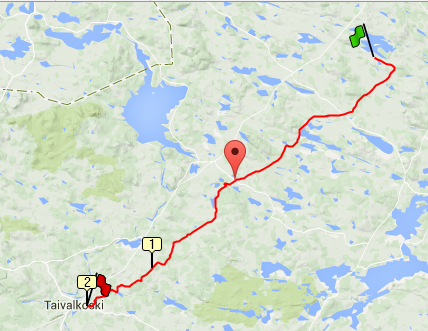
Well the shortest day is only some 49km. We start this day with a group photo outside the hotel before skiing off. Our usual route takes us up alongside the zoo. Today is gale force winds and at times we are exposed for a kilometre or two and you really do start to get the impression of how bleak and isolated it is. I live in Somerset, one of the largest and least populated counties in England. Ranua commune is about the same size, but has about 1% of the population - about twice the population of my village (Brent Knoll).
Today's skiing is about covering the distance with minimum effort to allow the body to recover as much as possible.
The friendly polar bear is at Ruona (the upward kink in the track on the map above). Half of us are bused back to the village hall there and the rest of us stay in the old school at Hosio. Sleeping bags are the order of the day (or should I say night) here.
Wednesday, 18 March 2015
Saturday, 14 March 2015
RR day 4 - the longest day
Again, the conditions were changeable - ice, snow, sleet, rain. I made it down the narrow steep slope with only a very minor fall, and was well pleased with myself. However, I really do need to work on my technical skiing - mostly to get the leg and ankle muscles to control the skis better - probably some skating would help - it would certainly improve my balance.
Between the two rest stops with the coaches, I did not see a single skier - the few slower ones behind me were left behind, or took the coach, and the faster ones were all well in front. It was slower and harder going than I had hoped. The general consensus was that the second rest stop had to be cleared by 2pm if you wanted to pass the last stop/checkpoint before the course was closed for safety as night falls. I did make it through here just by that time - the hot soup was definitely a nice reviver.
I occasionally caught up a Finnish lady skiing ahead of me - she would be pulling out of a rest stop as I arrived, but eventually she was out of reach. Suddenly as the temperature dropped as the sun was lowering late afternoon, the track got icy and I found I was able to double pole along at some 12-13km and sustain it for a long time. I overhauled the deficit to the lady in front and passed her, but she then caught on to the same trick and followed me closely all the way into the final checkpoint. However, with the sun having gone below the horizon (it takes about an hour and a half before it is dark at this latitude and time of year), we were too late to be let through for the final few kilometres.
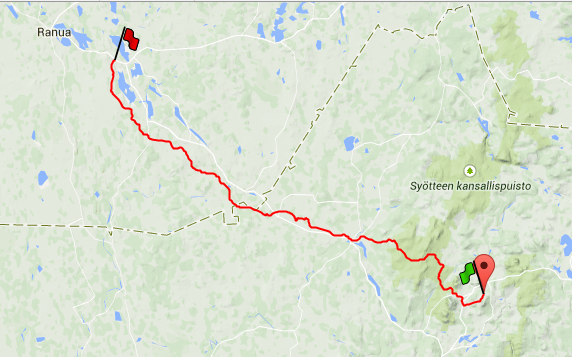
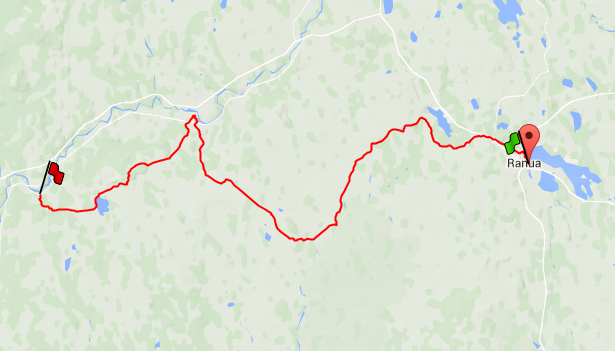
Today's track:
The real finish point is just above the "n" in Ranua.
Between the two rest stops with the coaches, I did not see a single skier - the few slower ones behind me were left behind, or took the coach, and the faster ones were all well in front. It was slower and harder going than I had hoped. The general consensus was that the second rest stop had to be cleared by 2pm if you wanted to pass the last stop/checkpoint before the course was closed for safety as night falls. I did make it through here just by that time - the hot soup was definitely a nice reviver.
I occasionally caught up a Finnish lady skiing ahead of me - she would be pulling out of a rest stop as I arrived, but eventually she was out of reach. Suddenly as the temperature dropped as the sun was lowering late afternoon, the track got icy and I found I was able to double pole along at some 12-13km and sustain it for a long time. I overhauled the deficit to the lady in front and passed her, but she then caught on to the same trick and followed me closely all the way into the final checkpoint. However, with the sun having gone below the horizon (it takes about an hour and a half before it is dark at this latitude and time of year), we were too late to be let through for the final few kilometres.
Today's track:
The real finish point is just above the "n" in Ranua.
Saturday, 7 March 2015
RR day 3 - even more challenging conditions.
A good an uneventful moring, except for having to ski with my older, shorter (145cm) poles. Even though I only changed back up to 150cm poles after 3 years with shorter poles, it goes to show that the shorter poles did the job of getting me to hold them better and not getting tangled up in them, but 150cm is definitely the right length, and I could finally see how much more I am getting out of that extra length.
A little after the lunch stop, the sky turned dark, the wind picked up and it began to snow. Before long, the track was hard to find - even obliterated in places. Sometimes, you were skiing by trying to feel for the tracks (something I have had experience of before).
Towards the end, my skis started to ice up. The first time, I just scraped the ice off the skintec kick zone. Later on, the whole skis felt leaden and stuck to the ground. Checking the skis, even the glide zone was sticking. So to make the last couple of kilometers, drastic measures were called for. Knowing that I have a brand new set of the two stripe skintec modules (carried with me now, after yesterday's incident), and that these have some mileage on the clock (400km), I decided to experiment, and after clearing the snow and as much of the ice as I could, put a layer of liquid glide wax from end to end of the skis, including on the skintec grip zone. The skis were completely transformed, not only gliding well, but also the kick performing well. It was good to get good glide and predictable behaviour Just in time, as the final part of the day is to use the drag lift to get to the centre on the top of the mountain.
This provided some useful learning.
A little after the lunch stop, the sky turned dark, the wind picked up and it began to snow. Before long, the track was hard to find - even obliterated in places. Sometimes, you were skiing by trying to feel for the tracks (something I have had experience of before).
Towards the end, my skis started to ice up. The first time, I just scraped the ice off the skintec kick zone. Later on, the whole skis felt leaden and stuck to the ground. Checking the skis, even the glide zone was sticking. So to make the last couple of kilometers, drastic measures were called for. Knowing that I have a brand new set of the two stripe skintec modules (carried with me now, after yesterday's incident), and that these have some mileage on the clock (400km), I decided to experiment, and after clearing the snow and as much of the ice as I could, put a layer of liquid glide wax from end to end of the skis, including on the skintec grip zone. The skis were completely transformed, not only gliding well, but also the kick performing well. It was good to get good glide and predictable behaviour Just in time, as the final part of the day is to use the drag lift to get to the centre on the top of the mountain.
This provided some useful learning.
- I did not expect the glide zone to ice up. But if faced with these conditions again after skiing some distance, I will be quicker to brush on some liquid glide wax.
- I will track down some proper anti-icing for the waxless skis. But in the meantime, I now know that liquid glide wax is at least a potential problem solver in extreme conditions.
- In these extreme conditions, it makes sense to periodically check the skintec modules for icing. Also, test out if anti-icing will keep the keyhole free of ice to be able to quickly change modules.
I will have to investigate other means of de-icing - will some of these thermal hand warmers provide a means of thawing them out? If the air temperature is above zero, then swapping the modules out with spares from time to time would allow the modules not in contact with the tracks to thaw out.
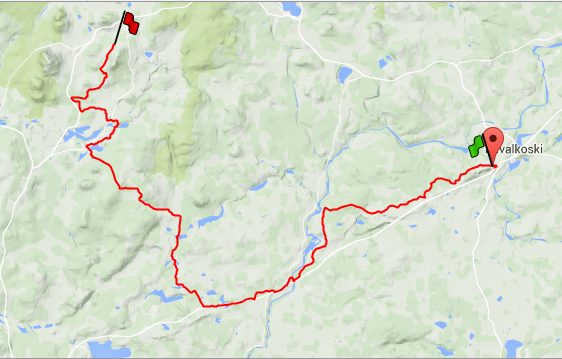
Here is today's route:
RR day 2 -some challenging skiing conditions.
On the bus to the starting point, a friend asked me if magnets were strong enough to hold the modules in place on the skintecs. At this point, I had never had any problems, but this would come back to haunt me before the day was out.
The first half of the day is 30km mostly along an old railway track. Without pushing too hard, I did this in record time - about three and a half hours, arriving just before midday. It gives me a bit of confidence that despite a drop off on my balance and technical skiing, never good at the best of times (and redeemed a bit later in the day on some tricky steep slopes), I can at least pound out the kilometers on the more gentle parts of the course.
However, around the three quarter point, I was having a bit of trouble with the skis sticking, so stopped to check them before a steep descent. Horror, of horrors - one skintec module was missing. I let people at the back know to keep an eye open for it, but a kind skier had found it and caught me up just before the finish to reunite me with it. Fortunately, I had been carrying the better grip modules as spares.
It highlights a couple of interesting points. Firstly, how did it come to be lost? On examination when I found I had lost it, the other module had some icing. I suspect there is a point where a module ices up and the grip of the ice to the snow/ice below is greater than the attraction between the magnets. But it also shows that under some circumstances, the snow packing into the cavity left when a module is removed can provide decent grip, if slightly sticky and unpredictable. This does at least give an option to try in tricky conditions when all else has failed.
The conditions this happened in was freshly falling snow, just above zero, perhaps just below as the point at which it happened was on a climb.
A nice gentle day, except for the hills at the end.
The first half of the day is 30km mostly along an old railway track. Without pushing too hard, I did this in record time - about three and a half hours, arriving just before midday. It gives me a bit of confidence that despite a drop off on my balance and technical skiing, never good at the best of times (and redeemed a bit later in the day on some tricky steep slopes), I can at least pound out the kilometers on the more gentle parts of the course.
However, around the three quarter point, I was having a bit of trouble with the skis sticking, so stopped to check them before a steep descent. Horror, of horrors - one skintec module was missing. I let people at the back know to keep an eye open for it, but a kind skier had found it and caught me up just before the finish to reunite me with it. Fortunately, I had been carrying the better grip modules as spares.
It highlights a couple of interesting points. Firstly, how did it come to be lost? On examination when I found I had lost it, the other module had some icing. I suspect there is a point where a module ices up and the grip of the ice to the snow/ice below is greater than the attraction between the magnets. But it also shows that under some circumstances, the snow packing into the cavity left when a module is removed can provide decent grip, if slightly sticky and unpredictable. This does at least give an option to try in tricky conditions when all else has failed.
The conditions this happened in was freshly falling snow, just above zero, perhaps just below as the point at which it happened was on a climb.
A nice gentle day, except for the hills at the end.
RR day 1 the tortoise and the hare or to wax or not to wax!
For my first RR back
in 2010 I arrived in Kuusamo with a single pair of traditional waxless skis. Or
rather I arrived 24 hours before my skis. So I spent the first day on rented
waxed skis. Testing back to back convinced me at that time that the extra effort
required of waxless skis on an endurance event was too high a price to pay.
Since then, I have
on tricky occasions on subsequent RRs tried waxless again but never found the
advantages to outweigh the disadvantages.
So despite testing
it was with great trepidation that I stood at the start of the RR on waxless
skis. The first few kilometres were exciting but that was down to a lack of
technical skills on my part and a
recovering ankle.
The skintecs worked
well. Frequently people would pass me only to stop and re wax skis trying to
find something that worked.
After the soup stop in early afternoon, I swapped out the double strip (better glide and less kick) for the full width single strip (more kick/grip and less glide). I did find a minor problem when trying to change - the little hole for the key gets filled with ice and it takes a while to prise the ice out to be able to get the key in to swap.
But all in all, they cope very well with changing conditions from below zero to above zero, from loose fresh snow to pack ice in the tracks.
Today was a total of 61.65km according to the GPS - from close to the Russian border through to the top end of the city of Kuusamo - as shown on the map.
As can be seen from the picture of me at the start, I am not very good at selfies, especially with gloves and with by breath fogging it up.
I arrived in Kuusamo at 5.30pm - about the time I normally arrive. But I took it steady today in order to save energy. The mistake I made in my first year was to put too much effort into the first day. This is not a mistake I have ever made again. For someone with my level of fitness, conservation of energy is important if I am to make it through the week.
Tuesday, 3 March 2015
Last minute training - part 2
Well sometimes the results defy all logic. Having done 7 laps of a pretty much flat 7.35km circuit round the lake yesterday, today I did more, but with variations on skis. This is the training circuit I have been using in Kuusamo - starting and finishing behind the Sokos hotel.
I expected to find that waxed skis were faster. This is NOT what happened. I had to exclude the first lap, as the tracks had not been recently prepared and it was fresh snow. So the effort was higher and the time longer, as would be expected.
To cut down on the number of tests, I am comparing skis that have not had glide wax ironed on for quite a while - so the glide on both waxed and waxless (skintecs) is typical more of what it is at the end of a long day's skiing. It also takes another variable out of the equation.
For the second lap, I put the full width skintec module in for the first time - this should give more grip but glide less well. It pretty much matched the second lap of yesterday on every measurement - not what would be expected unless today's conditions are faster; the temperature is the same +1C rising to +2C.
For the third lap, waxed skis - my Salomons - with a red wax. Definitely not as good a grip, but when repeated later, with the grip wax redone, the grip was pretty good, going up the same short inclines much as the waxless did. This lap was slower and more effort.
Lap 4, after lunch, back on the skintecs - heart rate and effort higher - very much as yesterday's lap 4 - so it is consistent (and demonstrates why you don't ski on a big meal).
Lap 5 - back on the waxed Salomons, and the slowest lap of the two days. The waxing was good, at least to start, but towards the end of 7km, it felt like it had been abraded off.
And the conclusions are:
I expected to find that waxed skis were faster. This is NOT what happened. I had to exclude the first lap, as the tracks had not been recently prepared and it was fresh snow. So the effort was higher and the time longer, as would be expected.
To cut down on the number of tests, I am comparing skis that have not had glide wax ironed on for quite a while - so the glide on both waxed and waxless (skintecs) is typical more of what it is at the end of a long day's skiing. It also takes another variable out of the equation.
For the second lap, I put the full width skintec module in for the first time - this should give more grip but glide less well. It pretty much matched the second lap of yesterday on every measurement - not what would be expected unless today's conditions are faster; the temperature is the same +1C rising to +2C.
For the third lap, waxed skis - my Salomons - with a red wax. Definitely not as good a grip, but when repeated later, with the grip wax redone, the grip was pretty good, going up the same short inclines much as the waxless did. This lap was slower and more effort.
Lap 4, after lunch, back on the skintecs - heart rate and effort higher - very much as yesterday's lap 4 - so it is consistent (and demonstrates why you don't ski on a big meal).
Lap 5 - back on the waxed Salomons, and the slowest lap of the two days. The waxing was good, at least to start, but towards the end of 7km, it felt like it had been abraded off.
And the conclusions are:
- In tricky conditions, the skintecs move from fresh snow to ice to corn snow without any problems. On the other hand, with the waxed skis, the waxing that was good for the tracks was not so good when stepping out into fresh snow and sticking if you came to a stop. For a skier with poor balance like me, this is definitely a plus point for the skintecs.
- On the very slight downhills, the waxed skis did glide slightly better and I was just able to double pole for a bit longer. And although they seemed to glide better, the GPS and effort measurements suggest that at least for me and this set of tests, this was an illusion.
- So why are the skintecs better? They should not be! Well the guy who sold me them (in Norway) said they didn't lose much on the glide. And his workshop had a stack of calibrated skis that he and a colleague use for glide wax testing, so although he didn't give me a figure, his "not much" is maybe something I can't measure. It could well be that I am gaining more from a better kick than I am losing on the glide.
- At the end of the day, someone told me that today's conditions were tricky, so it might just be that round that particular circuit, the changing conditions are such that I am gaining from the wide operating range of the skintecs, compared to it not being possible to optimise waxed skis (at least not when I am waxing them) for a varying set of conditions.
All very interesting. I still find it hard to believe the results, but there they are. The reason this is all so critical to me is that I have only just got the strength/endurance to complete 60-90km per day, and any extra effort required may be just that bit too much.
As can be seen in the above diagram of a week's training, you don't have time to recover from each day's exertion before you start on the next, and most of the above was skiing much shorter distances in Norway, although it did include a lot more climbing - as much most days as for the whole RR. My fitness levels have improved, as a 50% greater training load did not push me up as far into the red. The image above is not cropped - literally I end up going off the top of the scale.
Monday, 2 March 2015
Last minute training - part 1
Sunday 1 March
22 km in morning.
New track round the lake some 7 km is flat. Challenging in places with wind
blown fine snow; icy in other parts. Two circuits of the Tolpaniemi track on
the skintecs was illuminating. I had a fall which resulted in a slight twist of
the ankle at what is my Achilles heel when skiing - namely a fast corner at the
bottom of a hill. Good skiers push off on the corner, but this results in the outer track being
broken. When I get to it my outer ski tries to follow it and go straight on.
In the afternoon I
did the Kuusamo town loop with my newer boots as they have more ankle support.
I also strapped the ankle up.
So what did I learn?
My circuit of the town loop was a few minutes slower than last year but
massively quicker than two years ago. Also, it is possible to strap an ankle up
and still get it into a ski boot and ski without chafing.
At lunchtime I had
taken a closer look at the skintec module and it looked more worn than I
expected. At the end of the day I cleaned it up and it looked better, but I thought that although I have the full
grip module unused it might be wise to get a spare set. So I looked up Atomic
dealers. Intersport is the one in Kuusamo but not open on Sundays.
Monday 2 March
First thing on
Monday I skied round to Intersport. Walked down to skis and my hopes were
raised - Atomic skintecs. But alas, they were the touring version which doesn't
have the replacement module. I guess these are aimed at people who do not ski
so much. I thought I didn't do much at 800km in a year.
Anyway, after a few phone calls and the mention of
the Rajalta Rajalle Hiihto, they can get them for Wednesday. I am not sure if they are coming from
Helsinki or if they are having to get them in from Austria.
The RR may not be so
widely known outside of Lapland despite being the world's longest cross country
ski event but up here it is important.
One of the Sokos hotel's receptionist's husband is the safety snowmobile
driver on our first day.
So how did the
skiing go today? Well it started at
+1C and rose a degree during the day.
Today I decided to do my endurance test rather than risk stressing the ankle.
Since last year they have built a loop round the lake in front of the hotel
which is just over 7km and more or less
flat. This was incredibly busy which for a weekday in somewhere that isn't
especially a resort (that is Ruka 20km up the road).
So I got just over 7
laps -a bit over 50km done (53.6km to be precise). This shows
me that I have the endurance so I can cut down the distance for the next couple
of days to recover. Comparing lap to lap, it appears that I got slower throughout the day but that the training load went up from morning to afternoon, but it was fairly constant for the last three laps in the afternoon.
On enquiring if
today was fast, slow or tricky conditions,
I was told that they were tricky. The skintecs performed flawlessly -
probably a bit slower where snow had blown into the tracks. Not scientific, but on a one degree slope down I was double
poling and keeping pace for a while with those skating - normally much quicker
if you have the ankle strength and can maintain a higher energy output.
So I think that
regardless of scientific testing, for me
they work well and provide a level of confidence that I can take anything in my
stride. They seem good on ice crossing roads and other icy patches. The guy who
sold them to me that I would no longer be like Bambi and so far these skis have
been everything he said they would be.
Good equipment has
an attention to detail. For example, my
small new rucksack has the chest strap higher than most so that it clears the
heart monitor chest strap. But then it is designed for cross country skiing and
mountain biking - people who commonly monitor their performance.
So tomorrow I may do some comparative tests and cut the distance back to about 25-30km and around 15km on Wednesday to allow the body to recover a bit. Professional sports people have trainers to help them figure out how to optimise this, but I have only the one gruelling event each year, so I won't be able to apply this year's "lessons learned" until this time next year.
Subscribe to:
Posts (Atom)